

Complete Hotel booking websites Guide for Success
The lowest nightly rate isn’t always the lowest hotel bill. Hotel booking websites may display taxes and fees differently, so compare the total before choosing a stay. In Ireland, hotel charges, including taxes and fees, must be announced upfront under EU regulations.
It’s easy to assume that the first appealing price tells the whole story. But availability, cancellation terms, and what’s included can all affect which option works best for your trip.
This guide helps you compare booking sites and apps with confidence. Learn what to look for in displayed prices, how to weigh member savings and search tools, and how to find stays in destinations around the world.
We’ll also explain the differences between booking platforms, metasearch tools, and hotel websites, so you can choose an approach that fits your plans. A few practical checks make it easier to compare like for like and find a stay that suits your budget and travel needs.
Key Takeaways
- Compare the final trip total, not just the first nightly rate, and review how taxes, fees, and cancellation terms appear before booking.
- Search results depend on your destination, dates, room needs, and filters, so adjust these details to uncover stays that suit your trip.
- Online travel agencies handle bookings, while metasearch tools compare offers across sources; understand the difference before choosing where to reserve.
- Member savings can vary by platform: some online travel agencies offer 4% to 6%, while hotel aggregators typically offer about 1% to 2%.
- Choose a search tool based on what matters most to you, such as broad comparisons, clear booking terms, or a specific hotel’s own offers.

Comparing hotel booking websites and apps
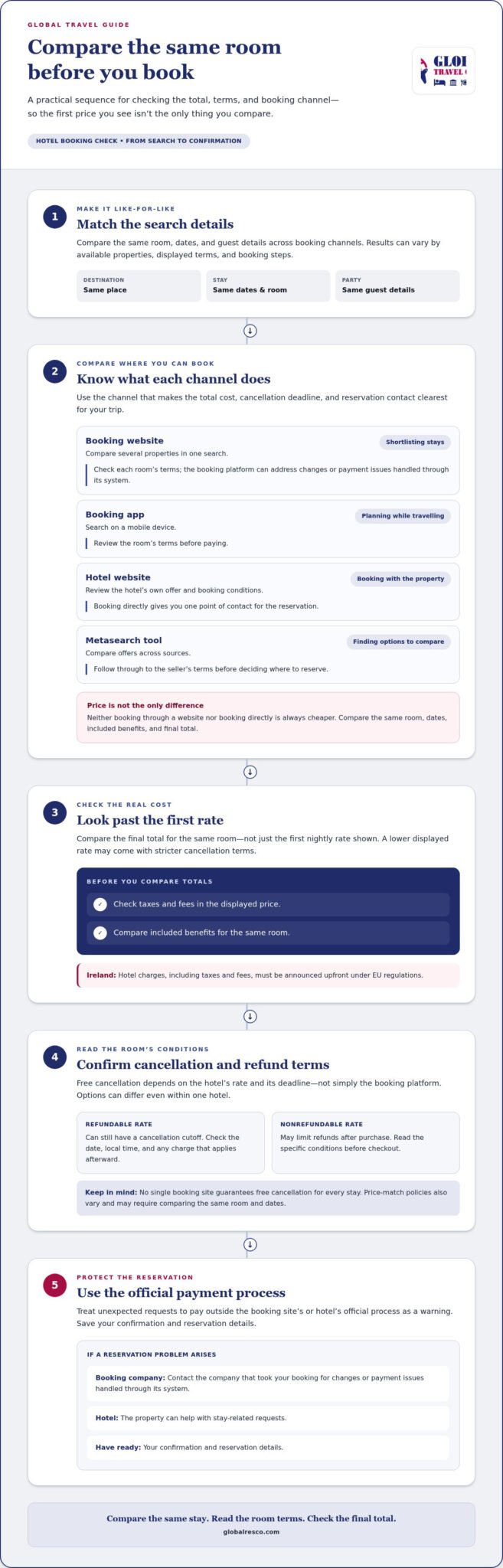
Compare the same room, dates, and guest details across booking channels. Then check the total, cancellation terms, and who handles reservation changes.
Hotel Booking Sites in the United States
For U.S. stays, booking sites and apps let you search by destination, dates, and room needs. Results can vary in available properties, displayed terms, and booking steps. Compare the final total for the same room, not just the first rate shown. In Ireland, hotel charges, including taxes and fees, must be announced upfront under EU regulations.
Flexible Cancellation Policies
Free cancellation depends on the hotel’s rate and its deadline, not simply the booking platform. Before paying, check the cancellation date, local time, and any charge that applies afterward. Some rates are nonrefundable, while others allow cancellation under stated terms. Filter for flexible options, then open the room details to read the conditions.
No single booking site guarantees free cancellation for every stay. Compare the terms attached to each room, since options can differ even within one hotel.
Booking Through Websites vs. Directly
Booking through a website can make it easier to compare multiple hotels in one search. Booking directly with a hotel gives you one point of contact for the reservation. Neither route is always cheaper: compare the same room, dates, included benefits, and final total. A lower displayed rate, for example, may come with stricter cancellation terms.
To avoid scams, use the booking site’s or hotel’s official payment process. Treat unexpected requests to pay outside that process as a warning, and save your confirmation and reservation details.
Cancellation, Refund, and Price-Match Rules
Cancellation and refund terms depend on the rate you select and the deadline shown before booking. A refundable reservation can still have a cutoff, while a nonrefundable rate may limit refunds after purchase. Price-match policies vary by site and may set conditions for comparing the same room and dates. Read the specific terms before checkout.
If a reservation problem arises, contact the company that took your booking and have your confirmation details ready. The hotel can help with stay-related requests, while the booking platform can address changes or payment issues handled through its system.
| Booking option | Price comparison | Cancellation details | Best fit |
|---|---|---|---|
| Booking website | Compare several properties | Check each room’s terms | Shortlisting stays |
| Booking app | Search on a mobile device | Review terms before paying | Planning while travelling |
| Hotel website | Review the hotel’s own offer | Read its booking conditions | Booking with the property |
| Metasearch tool | Compare offers across sources | Follow through to the seller’s terms | Finding options to compare |
Choose the channel that makes the total cost, cancellation deadline, and reservation contact clearest for your trip.
Hotel availability in destinations worldwide
Search results on hotel booking websites vary by destination, travel dates, room type, and guest details. A listing for one city doesn’t predict availability in another. Compare the same dates and room requirements across destinations, then open each property’s details. This helps you distinguish a room that’s available from a result that doesn’t match your plans.
For example, two-night stays from October 30 to November 1 show different options in Charlotte and Savannah. These examples show why searching a specific destination matters: even properties with similar names can have different availability and listed rates.
Savannah’s examples also show a range of choices within one destination. Compare location, room details, and included features alongside the rate. A lower price alone doesn’t show whether a property suits your itinerary.
- Enter the destination and exact travel dates.
- Set guest and room details to match your group.
- Compare properties and open their individual room listings.
- Review location and included features before deciding.
If a destination has few matching results, adjust your search deliberately. Try nearby neighborhoods or towns, then compare travel time to the places you plan to visit. If your dates are flexible, search alternate dates to see whether other properties appear. Keep guest numbers and room needs consistent so each result remains a useful comparison.
Find Accommodation
For international trips, search using local place names and check that the map pin marks the intended area. A city name can cover districts with very different access to transport, attractions, or event venues. Read the property address and room description instead of relying on the headline location alone.
Availability can also depend on the room category. A property may show rooms for one guest setup but not another, so update your search if your party or sleeping arrangements change. Check your dates again before booking, and make sure the confirmation reflects the destination, room, and guest details you searched.
Use search filters to narrow results, then remove them if the list looks unexpectedly small. A strict location, room, or feature filter can hide suitable stays nearby. Compare Charlotte Airport with central Charlotte only if either location works for your plans. This check can reveal practical alternatives while keeping you focused on where you need to be.
Online travel agencies and metasearch tools
Online travel agencies and metasearch tools both help travellers find stays, but they work differently. Knowing which one handles the booking helps you compare offers and understand where to manage your reservation.
An online travel agency displays rooms and lets you book through its platform. It presents property details, rate options, and reservation terms together. Some online travel agencies offer members savings of 4% to 6%. Compare the member rate with other available rates, then review its cancellation conditions before choosing.
A metasearch tool gathers hotel offers from different hotel booking websites and displays them side by side. Select a result to continue to the seller’s booking page, where you complete the reservation. Aggregator hotel booking websites typically offer member savings of about 1% to 2%. Their key role is comparison, rather than handling every part of the booking in one place.
Use an online travel agency when you want to browse properties and book within one platform. Choose a metasearch tool when your first priority is comparing offers from multiple sources. Either way, check that results match the same destination, dates, room type, and guest details. A rate for a different room or cancellation policy isn’t a direct comparison.
Try this simple process before booking:
- Enter your destination, dates, and guest details once.
- Compare the same hotel and room across the displayed options.
- Open the offer’s details and review what the rate includes.
- Check who takes the booking and provides reservation support.
- Save the selected offer and confirmation details for your records.
For example, a search for a city stay may show the same hotel through several sellers. Compare room descriptions and booking terms, not just headline rates. A lower offer might be for a different room or a less flexible rate. Matching the details makes your comparison more useful.
Member savings also need context. A 4% to 6% offer from an online travel agency and a 1% to 2% aggregator member saving apply to different platforms. Look at the final displayed amount and the conditions attached to the offer. Don’t assume a membership discount automatically makes one option the best fit.
After selecting an offer, note the seller’s name and booking reference. If you reserve through an agency, start with its booking channel for reservation questions. If a metasearch result takes you elsewhere, the booking provider shown at checkout is the contact for that reservation. Keep these details together to make your booking easier to find.
Types of hotel search engines
Hotel search tools serve different purposes. Before choosing where to search, identify whether a tool compares stays, completes reservations, or sends you to a hotel.
Online travel agencies combine hotel listings with booking steps. Search a destination, review room options, and reserve within the same platform. For a family stay in Chicago, for example, an agency search can help compare property locations and room setups. The agency also displays the terms attached to each selected rate.
Metasearch tools gather offers from multiple booking sources for comparison. Select a result to continue to the seller handling that offer. If a search for a Boston hotel shows the same property more than once, compare room names, dates, and cancellation terms. Similar-looking results may represent different offers.
Hotel-owned search tools show rooms and rates offered through a property’s own booking channel. They’re useful when you already have a hotel in mind, such as one near a specific conference venue. Review the room details and reservation conditions, then compare them with matching offers elsewhere.
General search engines and maps help with discovery and location. A map search can show whether a hotel is near a train station, downtown venue, or preferred neighborhood. Use the property’s address to judge the distance, then open the booking result to review the room and terms. A map pin alone doesn’t tell you what the rate includes.
Destination-focused search tools organize stays around a particular area or travel need. A search for a coastal town, for example, may surface properties across nearby communities. Check the map and address to make sure a result outside the town center still works for your plans. A useful tool helps you explore a defined region, but the property details remain essential.
Compare search tools by their purpose, not just their layout. An agency helps you book in one place. A metasearch tool helps you compare sellers. A hotel’s own search focuses on that property, while a map or destination search helps you assess location and discover alternatives.
- Start with an agency when you want listings and booking together.
- Use metasearch to compare offers for the same room and dates.
- Search a hotel directly when you know which property you want.
- Use maps to assess addresses, neighbourhoods, and nearby transport.
- Explore destination-focused results when nearby towns also suit your itinerary.
For a practical comparison, search the same destination, dates, and guest details using two types of tool. For example, compare a hotel found on a map with that property’s agency listing. Check the address, room category, and terms before deciding which result best fits your trip.
Map Based Search
This map shows available hotels in Madrid but you can pan, scroll, zoom in and out to find Accommodation anywhere in the world. Very useful!
What are the best hotel booking websites in the United States?
There isn’t one best choice of hotel booking websites for every U.S. trip. The right option depends on your destination, hotel type, cancellation needs, and how you prefer to compare stays. First decide whether you need broad search results, a particular property, or a way to compare booking offers. Then use the same dates and room requirements throughout your search.
For a coastal stay, search Myrtle Beach and compare properties that match your location and room needs. Breakers Resort Hotel and Courtyard by Marriott Myrtle Beach Barefoot Landing are examples of properties to compare. Their names alone don’t determine which booking channel suits you. Check the room details and terms for your chosen dates.
For a city trip, compare location as well as the property. In Charlotte, Sonesta Charlotte Lower South End and Motel 6-Charlotte, NC – Coliseum are examples of different properties to assess against your itinerary. Consider how each address fits your plans, then compare the available room descriptions and booking conditions.
Use these criteria to choose a search option that fits your trip:
- Broad comparison: Choose a tool that lets you view several properties for matching dates.
- One specific hotel: Search for the exact property, then review its room and reservation details.
- Flexible plans: Prioritize listings with clear cancellation deadlines and terms.
- Location needs: Use the address or map to assess distance from your planned activities.
- Easy follow-up: Note which company handles the reservation and where to find its confirmation.
| Search option | Useful for | Compare before choosing |
|---|---|---|
| Multi-property search | Exploring a destination | Room details and booking terms |
| Property search | Finding a specific hotel | Address and selected room |
| Offer comparison | Viewing different booking sources | Matching dates and conditions |
| Map-based search | Assessing hotel locations | Distance from your itinerary |
A practical approach is to shortlist a few properties, then compare the same room requirements across available booking options. For instance, a hotel near a Charlotte venue may suit your itinerary better than a similarly named property elsewhere. Check the full address, not just the city label, before deciding.
Before you reserve, confirm that the dates, guests, room type, and cancellation terms match your plans. Keep the reservation confirmation and booking contact together. For a wider trip plan, explore travel options for your U.S. stay alongside your hotel search.
GLOBAL TRAVEL GUIDE: Global Travel Guide
GLOBAL TRAVEL GUIDE can help you continue planning after comparing hotel search options. Its GLOBAL TRAVEL GUIDE supports destination research, while Tours & Tickets, Flights, and Accommodation help you explore other parts of your trip. Use these resources to shape an itinerary across destinations or plan activities alongside your stay. You can compare room details and booking terms while organizing the rest of your travel plans.
For a trip with several stops, start with the destinations and dates, then explore the relevant travel categories. This brings accommodation research together with destination ideas and activities.
Visit globalresco.com to explore GLOBAL TRAVEL GUIDE.
Turn Your Hotel Search Into a Trip Plan
Plan your stay around the experience you want, not just the reservation. Think about the places you hope to visit, how you’ll get between them, and what you’d like to do once you arrive. This wider view can help you choose where to stay and create a more connected itinerary.
Use hotel booking websites as one part of your planning, then build out the rest of your journey at a pace that suits you. GLOBAL TRAVEL GUIDE brings together destination inspiration with Tours & Tickets and Flights, helping you explore ideas beyond your room search.
Whether you’re planning a city break or a trip with several stops, a clear itinerary makes the next decisions easier. Choose a destination that excites you, outline what matters most, and take your next step with confidence.
Contact GLOBAL TRAVEL GUIDE to explore your travel plans, and get ready to enjoy the journey ahead.
Frequently Asked Questions
Do hotel booking sites show the full price including taxes and fees?
The first price isn’t always the final total, so review the amount shown before payment. How taxes and fees are displayed can vary by destination and booking channel. In Ireland, hotel charges, including taxes and fees, must be announced upfront under EU regulations. Elsewhere, look for a total-price breakdown at checkout and note whether any charges are payable at the property.
Do you still earn hotel loyalty points when booking through a third-party site?
Not always. A hotel loyalty program’s terms determine whether a third-party reservation earns points or qualifies for member benefits. Before booking, compare the rate’s eligibility with the value of any points you expect to earn. A discounted room that excludes points may suit a short stay, for example, while an eligible rate could matter more if you’re working toward a reward.
What’s the difference between an online travel agency and a metasearch site?
An online travel agency presents booking options and processes reservations through its platform. A metasearch site gathers offers from other booking sources and sends you to a seller to complete the reservation. Use an agency if you want to manage your booking in its system. Use metasearch to discover offers, then note which seller handles payment and reservation changes.
Which hotel booking sites and apps have rewards programs?
Some booking platforms and hotel groups offer rewards, but the benefits and eligibility rules differ. Look for account or membership terms explaining how rewards accrue and where they can be used. Compare those benefits with the room rate and cancellation conditions. A reward is useful only if it applies to your reservation and suits the way you plan to travel.
Which platforms are best for booking a hotel at the last minute?
Choose a platform that shows rooms for your exact arrival date and lets you complete the reservation promptly. Search with the correct number of guests, then focus on properties near your arrival point, such as an airport or train station. Open the room details before paying: even a quick booking needs to match your arrival time and stay requirements.
Which platforms let you book a hotel alongside other travel services?
Travel platforms may present accommodation alongside other trip-planning categories, with separate booking steps for each service. GLOBAL TRAVEL GUIDE offers Accommodation, Flights, Tours & Tickets, and Car Rentals as separate offerings. For example, use destination information to plan where to stay and explore activities for the same trip. Separate offerings don’t imply a bundled booking or price.
How do hotel booking websites compare on prices, fees, and available discounts?
Compare the same property, room, dates, and guest details to make price differences meaningful. Some online travel agencies offer members savings of 4% to 6%, while hotel aggregator websites typically offer member savings of about 1% to 2%. Compare the displayed total and discount conditions together. A membership offer matters only if you qualify and its terms suit your reservation.
How do hotel loyalty programs and rewards work when booking through third-party websites?
Third-party reservations follow the hotel program’s eligibility rules, so points and perks aren’t automatic. A program may distinguish between booking channels, room rates, or eligible stays. Review the conditions for the exact reservation, then decide whether points, status benefits, or the booking offer matter most. Keep your loyalty account details and reservation confirmation accessible if you need to connect the stay to your account.