
Hadrian’s Gate: Antalya’s Ancient Roman Marvel
Step back in time the moment you enter Antalya’s historic center. Hadrian’s Gate, locally known as Üçkapılar (The Three Gates), stands as a magnificent portal bridging the modern Turkish city with its ancient Roman past. This beautifully preserved triumphal arch is not just a stunning monument; it serves as the grand entrance to Kaleiçi, Antalya’s enchanting Old Town.
Location and How to Get There
Situated prominently on Atatürk Boulevard, Hadrian’s Gate marks the primary eastern entrance into the Kaleiçi district. It is easily accessible by walking from the city center, taking the modern AntRay tram to the Ismetpaşa station, or hailing a local taxi.
The heritage tram line has a dedicated stop: Üç Kapılar Trams run every 30 minutes from 7a.m. to 11p.m Use the Antalyakart Mobil app.
Walking from the city centre: From Republic Square- in the city centre , the gate is a 10 minute walk along Atatürk Caddesi at a leisurely pace.
Because it is surrounded by modern shops, palm trees, and busy streets, the stark contrast between the 21st-century city and the ancient Roman structure is immediately striking.
Best Time to visit: Spring (April–May) is the best time to visit. The temperature isaround 18–25°C – and before 9am the area is not crowded.
Autumn (September–October) is also good because the crowds are less, and the temperatures have cooled after the hot Summer.
A Brief History
The monumental gate was constructed in the year 130 AD to commemorate the visit of Roman Emperor Hadrian to the city of Attaleia (the ancient name for Antalya). Interestingly, for centuries, the gate was completely encased within the city’s outer defensive walls and largely forgotten by the outside world. This unintentional entombment is exactly why the structure remains in such pristine condition today. It was only fully exposed and restored in the 1950s when sections of the old city walls were removed, revealing the pristine marble beneath.
Type of Architecture
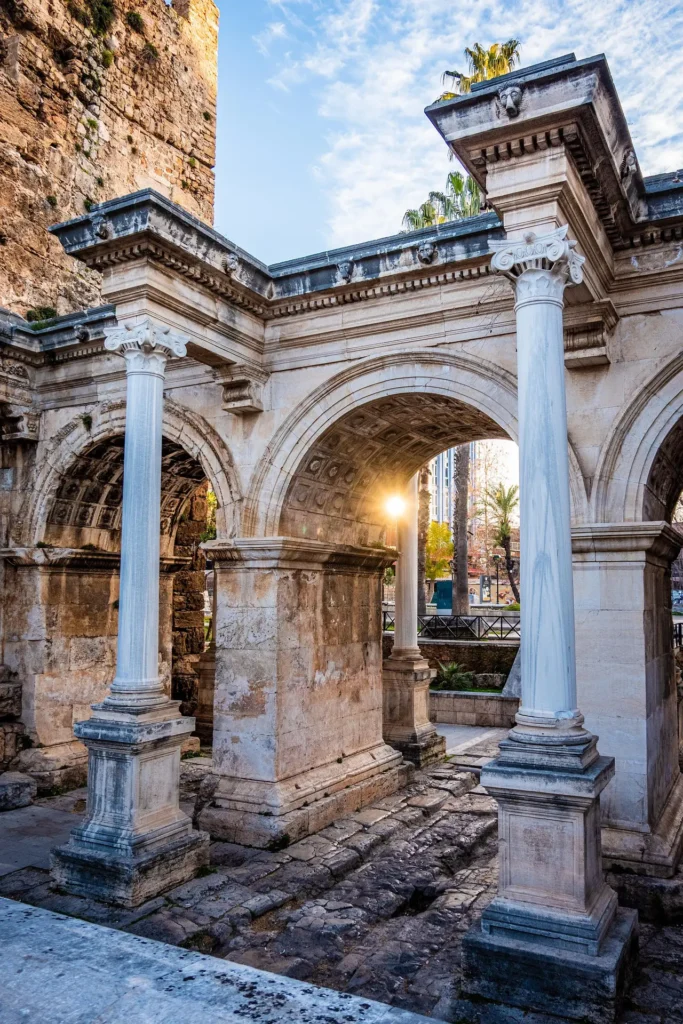
Hadrian’s Gate is a classic example of a Roman triumphal arch, but it stands out due to its unique triple-arched design.
- Built almost entirely of white marble, with the exception of the granite column shafts, the structure features four free-standing pillars on each facade, adorned with intricately carved Corinthian capitals. The ceiling vaults inside the arches showcase beautifully detailed floral rosettes and intricate coffering. The gate is bookended by two massive defensive towers that highlight different historical eras. The Southern Tower, known as the Julia Sancta tower, dates entirely back to the Roman era, while the Northern Tower features a Roman base with Seljuk Turkish masonry rebuilt on its upper half during the 13th century.
Interest to Visitors
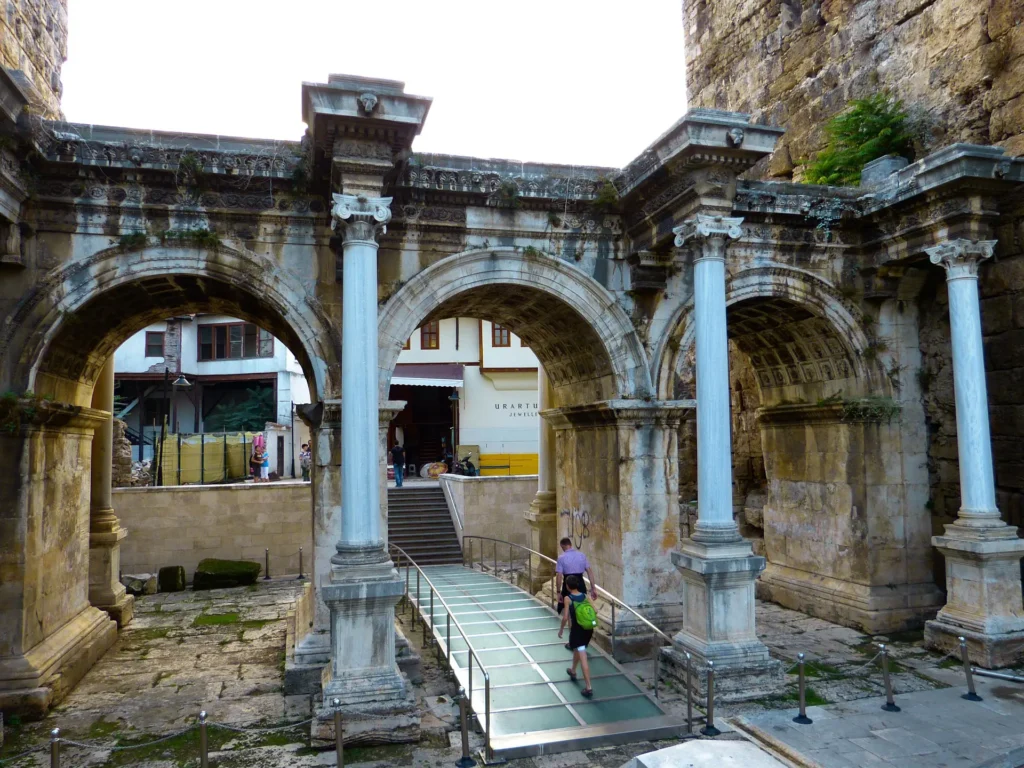
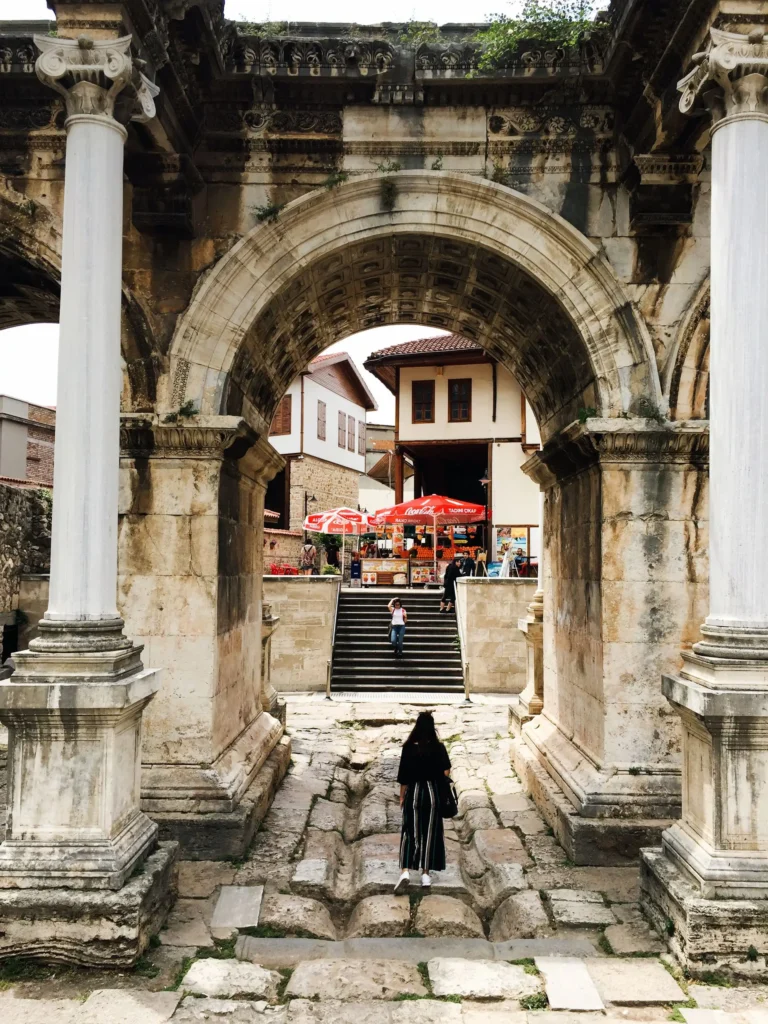
Walking through Hadrian’s Gate is a rite of passage for anyone visiting the Turkish Riviera. As you pass beneath the center arches, look down to see deep, parallel grooves worn into the original stone pavement.
These are the ancient wheel ruts left by centuries of Roman chariots and merchant carts passing through the city. Today, a clear, protective glass walkway hovers above these ruts, allowing you to view them clearly without causing further erosion to the ancient stone.
Furthermore, the gate is a premier photography spot, offering a stunning frame of the narrow, winding, cobblestone streets of Kaleiçi just beyond the arches. The monument is beautifully illuminated at night, making it equally magical for an evening stroll.
Practical Information for Visitors
| Visitor Detail | Information |
|---|---|
| Entrance Fee | Completely Free (0 USD) |
| Opening Hours | Open 24 hours a day, 7 days a week |
| Best Time to Visit | Early morning for crowd-free photos, or evening to see the illumination |
| Nearby Amenities | Cafes inside Kaleiçi (coffee costs approx. 3 to 5 USD), boutique shops, restaurants |
| Accessibility | The glass walkway makes the main arch wheelchair and stroller accessible |
Summary
Hadrian’s Gate is a must-see architectural masterpiece that beautifully anchors Antalya’s rich historical legacy. Built to honor a famous emperor and preserved purely by accident within the city walls, its white marble arches and imposing defensive towers offer a stunning transition from modern Turkey into the ancient world. It is of interest to architecture enthusiasts, a history buffs, or photographers, and is a marvellous sight for ordinary visitors to Antalya.