

New York City Attractions, Culture, Transit and Outdoor Life
Five boroughs make New York City a collection of distinct neighborhoods, attractions, and ways to explore. Its estimated population was 8,584,629 in 2025, and the city’s global reach is matched by the variety of experiences within its borders. From family outings to outdoor escapes, there’s plenty to plan around.
It’s easy to picture New York City’s famous skyline and busy streets first. But understanding how its boroughs fit together and how transit connects them can make a visit much easier to plan. A little context helps you choose what to see and how to get around.
Learn what makes each borough distinct, where culture and family-friendly attractions fit in, and why the city matters nationally and globally. This guide also covers population, traffic, public transportation, and outdoor activities, helping you shape a visit around the experiences that matter most to you.
Key Takeaways
- Compare the five boroughs to find the mix of culture, attractions, and family outings that best fits your visit.
- See how the city’s global role is reflected in its business, history, and cultural influence.
- Understand the difference between the city’s population and the larger metropolitan area when planning where to explore.
- Consider walking, biking, and public transportation when traffic or Gridlock Alert Days could affect your plans.
- Build a realistic trip budget around your accommodation, transport, and attraction choices, since these decisions shape overall costs.
Borough attractions and culture
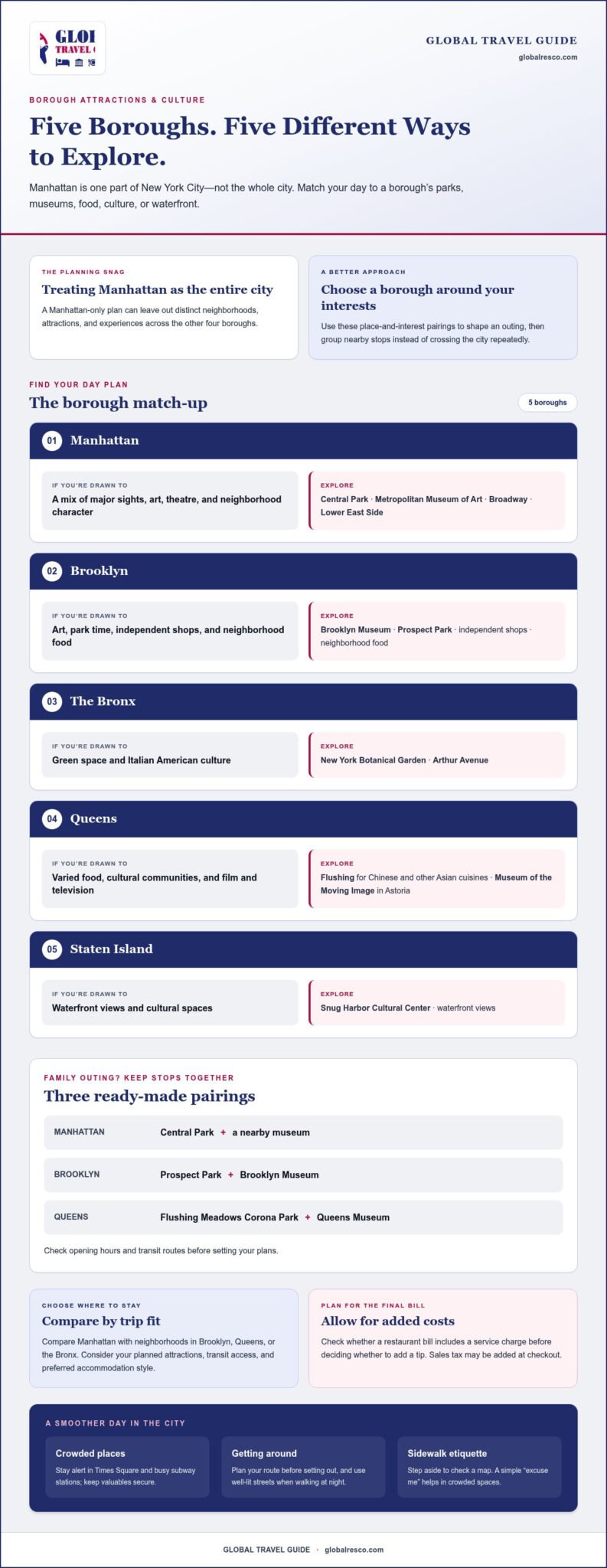
New York City has five boroughs: the Bronx, Brooklyn, Manhattan, Queens, and Staten Island. They are part of New York State, with neighborhoods shaped by waterfronts, parks, commercial centers, and residential streets. Manhattan is one borough, not the whole city, so exploring beyond it reveals a broader picture.
Each borough offers a different way to spend a day. Manhattan brings together Central Park, the Metropolitan Museum of Art, Broadway, and the Lower East Side. Brooklyn pairs the Brooklyn Museum with Prospect Park, independent shops, and neighborhood food. In the Bronx, the New York Botanical Garden and Arthur Avenue offer green space and Italian American culture.
Queens is known for its variety of food and cultural communities. Flushing offers Chinese and other Asian cuisines, while the Museum of the Moving Image in Astoria explores film and television. Staten Island adds waterfront views and the Snug Harbor Cultural Center. Use these examples to match an outing to a specific interest.
For a family outing, choose attractions that work well together rather than crossing the city repeatedly. Pair Central Park with a nearby museum, or plan a Brooklyn day around Prospect Park and the Brooklyn Museum. In Queens, combine a visit to Flushing Meadows Corona Park with the Queens Museum. Check opening hours and transit routes before setting your plans.
Rent and everyday living costs vary by neighborhood, housing type, household needs, and spending habits. Housing is a major factor for residents, while transport, groceries, and dining choices also shape a budget. Visitor expenses depend on different choices, including the length of the trip.
Stay alert in crowded places such as Times Square and busy subway stations. Keep valuables secure, plan your route before setting out, and use well-lit streets when walking at night.
To compare places to stay at different price points, look at Manhattan alongside neighborhoods in Brooklyn, Queens, or the Bronx. Choose based on your planned attractions, transit access, and preferred accommodation style rather than assuming one borough suits every traveler.
Local customs are easy to navigate with a little attention. At restaurants, check the bill for an included service charge before deciding whether to add a tip. Sales tax may be added at checkout, so account for the final total when shopping or dining.
New Yorkers often move quickly on busy sidewalks, so step aside when stopping to check a map. A simple “excuse me” helps in crowded spaces, and asking staff for directions can make a subway transfer easier. For a smoother day, group nearby places such as Central Park, Fifth Avenue, and the Museum of Modern Art into one outing.
New York City’s national and global importance
New York City’s influence reaches well beyond its five boroughs. Its economy, harbor, and cultural profile connect it with national and international networks. Visitors can see that influence in business districts, historic waterfront sites, and cultural institutions that draw people from around the world.
New York City’s gross domestic product was $1.378 trillion in 2024. The New York metropolitan area’s gross domestic product was $2.443 trillion that year. These figures show why the city matters economically, while the wider metro figure reflects activity across a larger region. Visitors can see that scale in the mix of office towers, hotels, restaurants, and services concentrated across the city.
The harbor helped build this importance. By the mid-1800s, New York handled more than half of the United States’ oceangoing travelers and commercial trade. Ships brought people and goods through the port, strengthening the city’s role as a national gateway. That history still shapes how visitors experience the waterfront, from harbor views to historic districts connected with shipping and immigration.
After 1900, New York was the world’s busiest port, holding that distinction until the 1950s. Port activity later shifted to the New Jersey side of the river after the 1960s. This change is a reminder that the region’s economic geography extends beyond the city limits. When planning a visit, distinguish attractions in the five boroughs from destinations elsewhere in the metropolitan area.
Global influence also appears in the city’s public landmarks. For three decades before its destruction in 2001, the World Trade Center was the most prominent symbol of New York City’s global prowess. The site remains associated with the city’s international role and its history. Including it in an itinerary adds context to the skyline and the city’s modern story.
These connections make the city more than a collection of famous sights. Its port history reflects early links with the wider world, while its economic scale shows its continuing reach. If you’re interested in architecture, focus on the Financial District; if migration history appeals to you, seek out places that tell stories of arrival and exchange. Choose the part of the city’s story you most want to explore.
Use the Global Travel Guide to connect this wider context with practical trip planning. It can help you consider destinations, travel arrangements, and the experiences that best match your interests.
Population and metropolitan area
Population figures depend on the boundary being counted. New York City refers to the five-borough area, while the New York metropolitan area includes a wider network of communities. The distinction matters when comparing totals or choosing where to stay. A hotel outside the city may still be in the metropolitan region, but the journey to New York City attractions will be longer.
The city had 8,175,133 residents in 2010 and 8,804,190 in 2020. Those census counts offer snapshots from two points in time, rather than a live measure of who lives there today. In 2020, the New York-Newark-Jersey City metropolitan area had 20,140,470 people. Its much larger total reflects the additional communities within that regional boundary.
Other population totals use different geographic definitions. The New York metropolitan area had a population of 19,426,449. This figure differs from the 2020 New York-Newark-Jersey City count, so don’t treat differently named areas as interchangeable. For a trip, the practical question is whether your accommodation and planned activities are within the five boroughs or farther across the region.
Density helps explain the city’s busy streets and close-packed neighborhoods. New York City’s population density is 29,303 people per square mile. That figure describes how residents are distributed across land, not how crowded every block feels. Midtown Manhattan, a residential street in Queens, and a park in the Bronx can offer very different experiences within the same city boundary.
Historical change adds another layer. During the 19th century, the city’s population grew from 60,000 to 3.43 million people. That expansion helped shape a dense urban landscape, with neighborhoods and transport routes developing across the boroughs. For visitors, it explains why a short distance on a map can still involve a different neighborhood character, transit connection, or pace of activity in New York City.
Use population figures as context, not as a travel forecast. The 2010 and 2020 counts describe residents, while the metropolitan total includes a broader area. A visitor planning a museum day in Manhattan may prioritize nearby accommodation and transit; someone visiting relatives in the wider region may need to account for travel beyond the city. Start with your main destinations, then compare their locations against your lodging.
For a practical comparison, list neighborhoods that fit your plans, such as Flushing in Queens or the Financial District in Manhattan. Then consider whether each stop is within the city or requires a regional journey. This distinction makes population data easier to interpret and keeps your itinerary focused on the places you want to experience.
Traffic and public transportation
Traffic can affect how much you see in New York City, especially when your itinerary crosses boroughs. A car offers door-to-door travel, but busy streets, limited curb space, and changing traffic conditions can make journey times unpredictable. For many visitors, combining public transportation with walking is a practical way to reach major sights.
The subway is useful for longer journeys across Manhattan and between boroughs. Buses can help when a subway station isn’t close to your destination, while walking suits shorter distances and lets you notice neighborhood details. Group nearby Manhattan attractions, then use transit for a separate outing in Brooklyn or Queens.
On designated Gridlock Alert Days, New York City asks people to consider walking, biking, or taking public transportation. These alerts indicate when traffic congestion is expected to be especially challenging. If your visit overlaps with one, avoid building a tight schedule around car travel. Choose stops near transit routes, allow flexibility between activities, and keep walking as an option.
Plan by geography, not just by attraction names. A morning at the American Museum of Natural History pairs naturally with Central Park, while another day can focus on the Brooklyn waterfront. This reduces backtracking and makes transit choices easier. Before you leave, check your route and service information, and identify a nearby alternative in case a line or street is disrupted.
Biking can suit visitors who want to explore a local area at their own pace. Choose a route that matches your comfort level, and account for traffic, crossings, and secure places to leave a bicycle. Walking is often best for short journeys through areas such as Greenwich Village or the Brooklyn Heights Promenade, where the route is part of the experience.
A taxi or rideshare can be convenient when you’re carrying luggage, traveling with children, or heading somewhere that’s awkward to reach by transit. Travel times may be less predictable in busy traffic. Weigh door-to-door convenience against possible delays, especially before a timed museum entry, Broadway performance, or train departure.
Keep your itinerary flexible. Save the addresses of key stops, group activities by neighborhood, and leave time between appointments. On a Gridlock Alert Day, prioritize public transportation, walking, or biking where practical. For a short stay in New York City, a transit-based plan can also make it easier to visit more than one borough without spending the day managing a car.
How much does a typical visit to New York City cost?
There’s no single typical total for a visit to New York City. Costs depend on trip length, travel dates, accommodation, meals, transport, and paid activities. A weekend of parks and neighborhood walks differs from a longer stay with Broadway tickets and several museums. Start by choosing the experiences that matter most, then build a budget around them. Your choices about accommodation and activities will have a strong effect on the final total.
Accommodation is often a major planning decision. Compare location, room type, and dates, not just the nightly rate. Staying near Times Square puts Broadway and Midtown sights nearby, while a place in Queens or Brooklyn will shape your transit plans. Estimate the full stay, including taxes and other charges shown during booking.
Food spending depends on your dining style. A day of coffee, bakery stops, and casual meals costs differently from one built around sit-down restaurants in Little Italy or the West Village. Plan one memorable meal and keep the others flexible. Checking menus ahead of time can help you decide where dining out matters most.
Attractions also affect your total. Broadway shows, observation decks, museums, and guided experiences each involve different spending choices. Balance ticketed activities with free options such as Central Park, the Brooklyn Bridge, and neighborhood walks. Review admission details and prioritize the experiences you’re least willing to miss.
Transport costs depend on how widely your plans are spread across the five boroughs. A day focused on nearby Manhattan sights may involve more walking, while visits to Queens, Brooklyn, or the Bronx add cross-city journeys. Public transportation, taxis, and rideshares suit different routes. Group nearby stops to avoid unnecessary trips and keep your schedule practical.
Make a simple budget with separate categories for accommodation, food, local transport, attractions, and shopping. Add known expenses, such as your hotel dates and a Broadway performance, then leave room for flexible choices like extra meals or museum visits. Revisit the totals if your plans change. This approach shows which decisions have the biggest effect without relying on a generic trip estimate.
Ready to turn your priorities into a practical itinerary? Plan your New York trip around the stays, travel arrangements, and experiences that suit you.
The landscape behind those walks reflects glacial recession that shaped much of New York City’s present topography about 10,000 years ago.
GLOBAL TRAVEL GUIDE: Global Travel Guide
GLOBAL TRAVEL GUIDE helps you organize a New York City trip. Use the Global Travel Guide to explore destination information, then browse Tours & Tickets for experiences that match your interests. Flights and Accommodation can help you plan the main parts of your journey alongside your neighborhood and transport choices.
Use these travel resources once you’ve decided what matters most, whether that’s exploring several boroughs, seeing a show, or visiting museums. Matching your plans with suitable travel arrangements makes it easier to build an itinerary around your priorities.
For help planning your next trip, visit globalresco.com.
Turn your plans into a trip you’ll enjoy
Let the kind of day you want guide your next decision. You might be looking for a culture-filled itinerary, a relaxed outdoor break, or a mix of both. Choosing a few personal priorities first can help you create a New York City trip that feels like yours, rather than a checklist of famous places.
Once you know what you want to experience, connect those interests with the practical parts of travel. GLOBAL TRAVEL GUIDE offers a Global Travel Guide, Tours & Tickets, and Flights to support your planning. Choose the experiences for your itinerary, then organize your journey around them at a pace that suits you.
Ready to take the next step? Contact GLOBAL TRAVEL GUIDE today and start shaping a trip that feels rewarding from the first day.
Frequently Asked Questions
Where is New York City and what are its five boroughs?
New York City is in southeastern New York State, where the Hudson River meets New York Harbor. Its five boroughs are the Bronx, Brooklyn, Manhattan, Queens, and Staten Island. The Bronx connects to the mainland, while the other boroughs include extensive waterfront areas. This layout helps explain why a trip between neighborhoods can involve bridges, tunnels, or water crossings, even when destinations appear close together on a map.
What is the population of New York City?
New York City’s estimated population in 2025 was 8,584,629. That figure counts residents within the city, not everyone living across the wider metropolitan area or visiting on a particular day. For travel planning, population gives useful context for the city’s busy public spaces, but neighborhood activity varies. A weekday in a business district, for example, can feel different from an evening in a residential area.
What are the main neighborhoods and attractions in New York City?
Neighborhoods and attractions suit different interests. Visit the High Line for an elevated park walk, Coney Island for its boardwalk and seaside setting, or Chinatown for shops and restaurants. Rockefeller Center offers a different Midtown experience, while Ellis Island adds immigration history to a harbor outing. Choose an area that interests you and group nearby stops, leaving time to explore its streets, cafés, and local shops.
How do you get around New York City using public transportation?
Use the subway for longer trips, then consider buses or walking for destinations farther from a station. Check the route direction and train type before boarding, as local and express trains may serve different stops. Compare the station nearest your destination with the walk from a nearby bus stop. Allow flexibility for transfers, and keep your next stop’s address handy when navigating unfamiliar stations.
What are the rules for driving, parking, and congestion pricing in New York City?
Driving, parking, and congestion pricing involve separate considerations. Follow curbside signs for street-parking restrictions, and review a garage’s posted terms before leaving your vehicle. Congestion pricing applies to driving into a designated area, while parking rules control where a vehicle may stop or remain. The applicable zone, time, and vehicle category determine how congestion-pricing rules apply, so account for these factors when planning a route by car.
What are the best areas to stay in New York City for different budgets?
Compare accommodation in Manhattan with options in Brooklyn, Queens, or the Bronx. Choose based on your planned attractions, transit access, and preferred accommodation style.